A flashlight can look simple: a battery, a switch, and a bright LED behind a lens. Inside, however, the driver quietly manages the relationship between them. It regulates current, responds to changing battery voltage, and helps keep brightness predictable as the cells discharge. That small circuit can shape runtime, heat, beam consistency, and reliability. The question “How do LED drivers work and why are they important in flashlight design?” therefore matters to anyone comparing compact lights, high-output models, or everyday carry options.
LED researcher E. Fred Schubert’s work on LED physics supports a central design principle: LEDs need controlled current, not merely a voltage source. This is a paraphrase, not a verbatim quotation. In practice, flashlight drivers may use linear regulation or switching circuits, including buck and boost designs. Each approach involves trade-offs in efficiency, heat, size, and output stability. A driver may also provide dimming, mode changes, and protection against overheating or low battery voltage. Small details matter. A faint flicker, a warm aluminum body, or a sudden drop in brightness can reveal how the circuit behaves.
This guide introduces China’s top 10 LED driver options for flashlights and explains how their designs work. It considers practical factors such as input voltage, regulated current, efficiency, thermal behavior, and compatibility with different LEDs. Rankings can vary with testing methods and application needs, so no single driver is best for every flashlight. Real-world results also depend on the battery, LED, housing, and firmware. That is worth remembering. A promising specification sheet does not always predict performance in a pocket-sized light.
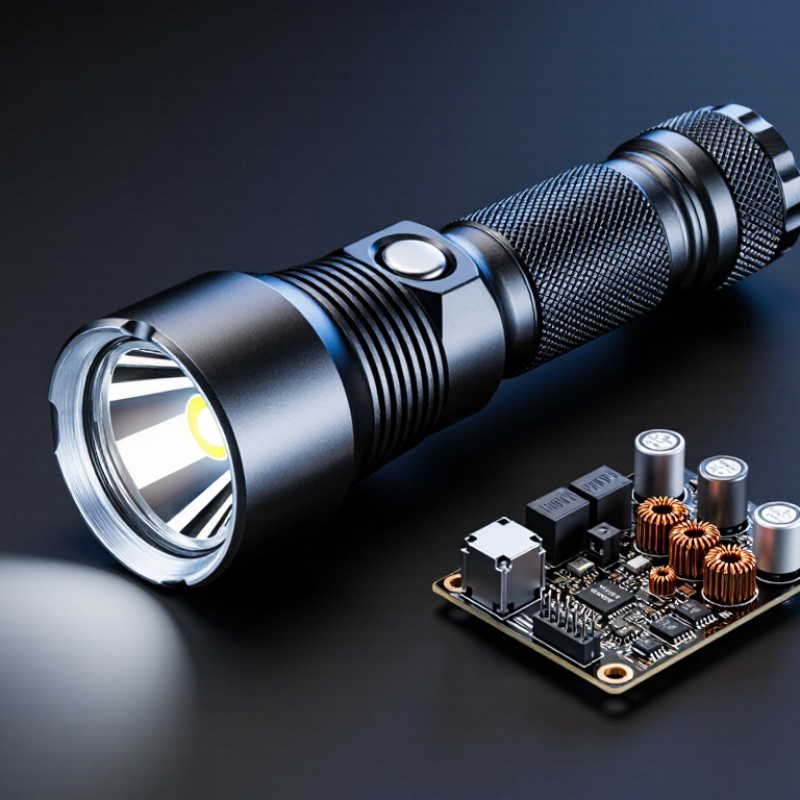
An LED driver controls the electrical current flowing from a flashlight’s battery to its LED. This matters because battery voltage changes as the cell drains, while an LED needs controlled current to shine consistently. Without suitable regulation, brightness may fall quickly or the LED may receive more current than it can safely handle. Drivers can use different circuit designs, such as buck, boost, or buck-boost regulation, depending on the battery and LED configuration.
In practical use, the driver also shapes how brightness changes between modes. Some designs maintain a steadier beam as the battery weakens; others allow visible dimming. A driver may support low, medium, and high settings, plus electronic switches or thermal protection. Not every flashlight includes every feature. The small circuit board is easy to overlook.
Tips: Check the flashlight’s manual for its recommended battery type and output modes. If the beam flickers or becomes unusually hot, stop using it and inspect the battery and device.
A well-matched driver helps balance brightness, runtime, and heat, but these goals can compete. High output often drains the battery faster and warms the head, especially during extended use. Some drivers reduce power when temperatures rise, helping protect the LED and internal parts. Performance still depends on the flashlight’s cooling design and the battery’s condition. It is a detail worth checking, not a magic fix.
| No. | Driver Type or Method | How It Works | Input and Output Relationship | Key Advantages | Limitations and Typical Use |
|---|---|---|---|---|---|
| 1 | Constant-Current Linear Regulator | A control circuit adjusts a series pass element to maintain a set LED current. Excess input voltage is dissipated mainly as heat. | Typically requires the battery voltage to exceed the LED forward voltage by the regulator’s required headroom. | Simple, low electrical noise, and accurate current regulation when there is sufficient voltage headroom. | Efficiency falls as the voltage difference and LED current increase. Often suited to low-power lights or configurations with a small voltage difference. |
| 2 | Buck (Step-Down) Converter | A switching circuit stores energy in an inductor and regulates its transfer to the LED load, usually using feedback to control current. | Designed to regulate when the input voltage is higher than the LED string voltage. | Can provide efficient, regulated output current when the battery voltage is above the LED voltage. | Cannot maintain regulation if the input falls below the required output voltage. Common with multi-cell battery packs and higher-voltage LED configurations. |
| 3 | Boost (Step-Up) Converter | A switching circuit charges an inductor and releases the stored energy at a higher voltage, while regulating LED current. | Designed for cases where the input voltage is lower than the LED string voltage. | Allows a low-voltage battery to power an LED load with a higher forward voltage. | Input current rises as battery voltage falls for a given output power. Common in single-cell lights driving higher-voltage LED arrangements. |
| 4 | Buck-Boost Converter | A switching converter adjusts energy transfer so the output can be regulated even as the input moves above or below the required LED voltage. | Can regulate across input conditions both higher and lower than the LED string voltage, within the circuit’s operating range. | Maintains regulated output through a wider battery-voltage range than a buck-only or boost-only design. | Usually involves greater circuit complexity and may have more switching components. Useful when battery voltage crosses the LED voltage during discharge. |
| 5 | SEPIC Converter | A switching topology using an inductor and a coupling capacitor to provide a non-inverting output that can be stepped up or down. | Can regulate when input voltage is either above or below the target output voltage, subject to design limits. | Supports a broad input-voltage range while keeping output polarity the same as the input. | Component count and switching losses can be higher than in simpler topologies. Used when the battery range spans the LED voltage. |
| 6 | Switched-Capacitor (Charge-Pump) Driver | Switches capacitors between circuit nodes to multiply or otherwise convert voltage, then controls current to the LED. | Often uses fixed conversion ratios, such as voltage doubling, rather than a continuously variable inductor-based conversion ratio. | Can be compact and avoids an inductor, which can be useful in small, low-power lights. | Conversion ratios and available output current are limited. More suitable for modest power levels than high-output flashlight designs. |
| 7 | Resistor-Based Current Limiting | A series resistor reduces current according to the voltage difference across it; it does not actively compensate for battery or LED changes. | Current varies with battery voltage and LED forward voltage. | Very simple and inexpensive, with few components. | Brightness and current can change substantially as the battery discharges or the LED heats up. Typically used in basic, low-cost lights rather than precision regulation. |
| 8 | Direct-Drive FET Switching | A MOSFET acts mainly as an electronic switch, connecting the battery to the LED with little active current regulation. | LED current depends strongly on battery voltage, cell resistance, wiring, switch resistance, and LED characteristics. | Can deliver high initial output with a simple, low-resistance power path. | Current and brightness generally decline as the battery voltage drops; peak current must be kept within battery and LED limits. It is a drive method, not inherently a regulated constant-current driver. |
| 9 | PWM Brightness Control | The driver rapidly switches LED current on and off. Changing the on-time proportion, or duty cycle, changes average light output. | Usually operates alongside a current-regulating stage; the LED’s on-state current is set by that stage or the circuit design. | Provides adjustable brightness without requiring the LED to operate continuously at a very low analog current. | Switching frequency and implementation affect visible flicker, camera banding, and electrical noise. PWM is a dimming method, not a voltage-conversion topology by itself. |
| 10 | Multi-Mode or Multi-Channel Driver | Control circuitry selects output levels or channels, for example by changing regulated current, switching modes, or selecting different LED paths. | May use a linear, buck, boost, buck-boost, or combined power stage; the input-output behavior depends on that underlying circuit. | Enables features such as multiple brightness levels, selectable emitters, and mode memory. | “Multi-mode” describes control and functionality rather than one specific power-conversion topology. Performance depends on the underlying driver and thermal design. |
How a flashlight LED driver helps: It manages electrical power from the battery to the LED, commonly by regulating current, converting voltage, controlling brightness, or providing protection. Actual performance depends on the circuit design, battery condition, LED configuration, and heat dissipation. The entries above describe driver types and control methods, not a ranked list of brands or products.
It controls current flowing from the battery to the LED. This helps manage brightness as battery voltage changes. Small board, big effect.
Some drivers maintain steadier brightness, while simpler designs may allow visible dimming. The result depends on the circuit and battery condition.
Check the battery’s voltage when fully charged and nearly depleted. Then confirm the driver supports that range and supplies current within the LED’s rated limits.
Constant-current regulation generally keeps brightness steadier as voltage falls. Direct drive is simpler, but brightness may drop with the battery. Neither choice fits every use.
Look for low-voltage cutoff, reverse-polarity protection, and thermal behavior. Not every flashlight includes these features, so check its specifications.
High output can drain the battery faster and warm the flashlight head. Some drivers reduce power as temperatures rise, but cooling design still matters.
Test it with the intended LED and battery, if possible. Check current stability, dimming, and temperature inside the flashlight housing. Bench results can differ.
No. Check the test conditions, including input voltage and current, and consider runtime, heat, and useful brightness settings. I would still test it twice.
This article explains the role of LED drivers in flashlights and the question: How do LED drivers work and why are they important in flashlight design? A driver controls the electrical current delivered to an LED, helping maintain steady brightness, manage power use, and protect the light from unstable input or excessive current. The article also outlines how current regulation works and introduces common driver types, highlighting how their features affect brightness, efficiency, heat, and runtime.
It also surveys China’s flashlight LED driver manufacturing sector, focusing on the kinds of capabilities buyers may encounter rather than naming individual brands. To compare and choose a suitable driver, readers can consider output requirements, battery compatibility, efficiency, thermal performance, size, reliability, and intended use. Together, these topics offer a practical guide to understanding flashlight driver design and making informed component choices.

 Geek Flashlight