Choosing a high-power LED driver can determine whether a flashlight delivers steady brightness or fades after a few minutes. The driver controls current between the battery and LED. It also influences heat, runtime, beam consistency, and component life. A small mistake may appear as flicker, excessive heat, or sudden shutdown in the field.
Why do high-power LED drivers matter in flashlight performance? The answer begins with current control. High-output LEDs can suffer damage when current rises beyond their safe limit. A suitable driver balances electrical demand with the battery’s changing voltage. It should also match the LED’s forward voltage, output rating, thermal design, and required regulation method. Steve Winder, author of Power Supplies for LED Driving, states, “An LED driver regulates current, not just voltage.” That principle remains important when comparing linear, buck, boost, and buck-boost designs.
Real-world testing adds details that specifications may hide. A driver may appear efficient on a datasheet, yet feel uncomfortably hot inside a compact aluminum body. Another model may provide impressive initial brightness but poor regulation as the battery discharges. Runtime matters. So does usability.
This guide examines practical selection factors, including efficiency, protection circuits, dimming behavior, thermal limits, and battery compatibility. It also questions a common assumption: maximum output is not always the best output. A slightly lower drive current may produce a cooler, more reliable flashlight. The right choice depends on the entire system, not one attractive number.
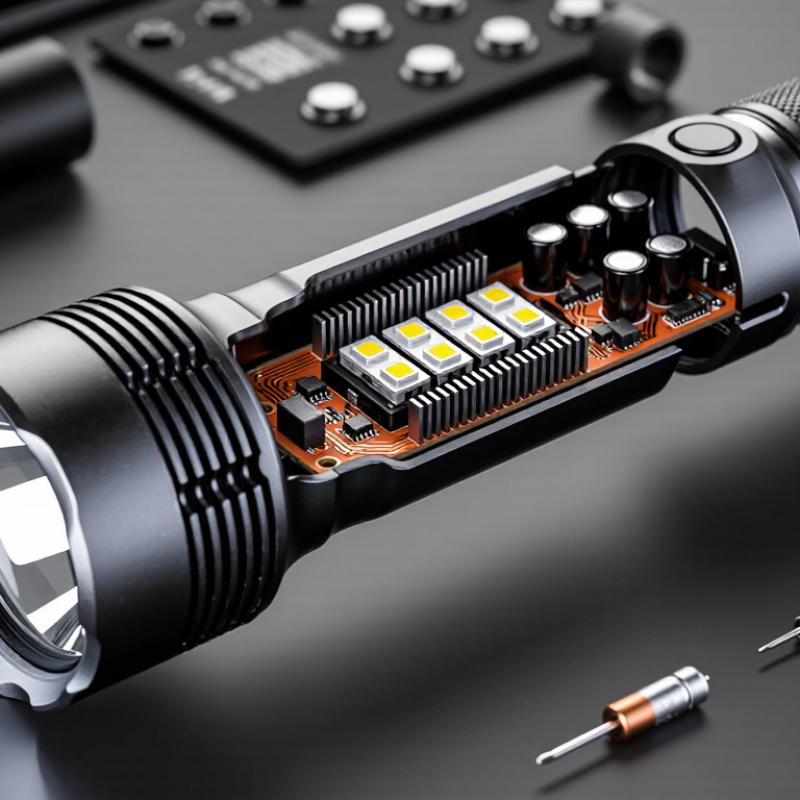
How to Choose High Power LED Drivers for Flashlights?
A high-power LED driver does more than switch light on. It controls current, manages battery voltage, and protects the LED from thermal stress. The U.S. Department of Energy’s 2023 Solid-State Lighting R&D Opportunities report notes that laboratory LED packages have exceeded 200 lumens per watt. Flashlight performance still depends heavily on the driver. Poor regulation can waste that potential.
Constant-current control is essential. It prevents brightness changes as the battery discharges. A buck driver suits higher battery voltage, while a boost driver supports lower voltage sources. Buck-boost designs handle both conditions, but often add circuit complexity. Check conversion efficiency at realistic loads, not only at the advertised maximum. Small losses become noticeable inside a compact aluminum body.
Heat matters greatly. IEC 62384 addresses performance requirements for LED controlgear, including electrical operation and safety-related behavior. A reliable design should include thermal regulation, over-current protection, and low-voltage monitoring. Shorter wires and clean solder joints also reduce resistance. Test the flashlight for ten minutes, then measure the body temperature. It may feel comfortable while the LED junction is already struggling. That detail is easy to miss. PWM dimming can create visible flicker or camera-band issues, so analog regulation may be preferable for sensitive work. Specifications are useful, but real measurements remain imperfect.
A high-power flashlight driver should be selected from the LED’s electrical requirements, not its advertised brightness. Check the LED datasheet for forward voltage at the intended current. A white LED may operate near 3 volts, while a multi-die model can require 6, 9, or 12 volts. Forward voltage also changes with temperature. When the LED heats, its voltage can fall slightly, increasing current in poorly controlled circuits.
Use a constant-current driver when stable brightness and LED protection matter. For example, a 3.0 V LED rated at 3 A needs about 9 watts before accounting for driver losses. A driver delivering 4 A may create excessive heat, even if the LED survives briefly. The U.S. Department of Energy’s 2022 Solid-State Lighting R&D Opportunities report notes that laboratory LED packages have exceeded 200 lumens per watt, but real products lose efficiency through optics, heat, and electronics. That gap matters in a compact flashlight.
Choose a driver with output headroom, thermal regulation, and efficiency data measured near your target load.
The IEA’s 2024 Energy Efficiency report identifies lighting as roughly 5% of global electricity demand, reinforcing the value of efficient conversion. Still, published efficiency figures can mislead. Test the complete flashlight at 25°C and after heat soak. Measure current at the battery, LED voltage, and body temperature. A small error here becomes uncomfortable heat.
Choosing a high-power LED driver starts with efficiency, not advertised output. A driver rated at 95% efficiency wastes less energy as heat. In a compact flashlight, that difference can create a hot head and shorter runtime. Check the input voltage range against the battery’s fully charged voltage and discharge point. A single lithium cell may move from 4.2 volts to below 3 volts. The driver must regulate safely across that range. I prefer datasheets with graphs, not only peak numbers. Peak figures can hide weak sustained performance.
Tips: Measure current at the LED, not only at the battery. Test brightness after ten minutes. Use a solid thermal path from the LED board to the flashlight body. Apply suitable thermal compound carefully. Keep the wiring short and secure. A driver with thermal regulation can reduce output before dangerous heat builds. This behavior may feel disappointing, but it protects the LED and battery. Ventilation still matters.
Battery compatibility also involves discharge capability, protection features, and cutoff voltage. A driver demanding high current can overwhelm a weak cell, causing voltage sag and unstable brightness. I once trusted a runtime estimate without checking real temperature, and the result was misleading. Real conditions include cold weather, dirty contacts, and imperfect batteries. Choose a driver with predictable regulation, clear protection data, and test results from continuous operation. Fancy modes matter less when the light cannot stay stable.
| Driver Type | Typical Input Range | Typical LED Current | Typical Efficiency | Heat Management | Battery Compatibility | Recommended Use |
|---|---|---|---|---|---|---|
| Linear Constant-Current Driver | 3.0–4.2 V for a single lithium-ion cell | 350–1,500 mA | 70–90% | Excess voltage is converted into heat; requires a metal host, thermal path, and thermal regulation. | Best suited to one-cell systems when the battery voltage is close to the LED forward voltage. | Simple, compact flashlights with low component count and moderate output. |
| Boost Constant-Current Driver | 0.9–4.2 V, depending on the design | 350–2,000 mA | 80–94% | Generally cooler than a linear driver when the input voltage is below the LED voltage, although the inductor and switching MOSFET still need airflow or thermal conduction. | Useful for one-cell operation with LEDs requiring a higher forward voltage than the battery can provide. | High-output flashlights using a single rechargeable cell or low-voltage battery pack. |
| Buck Constant-Current Driver | Typically 6.0–16.8 V | 700–5,000 mA | 85–97% | Efficient voltage reduction produces less heat than linear regulation; thermal design is still required at high current. | Suitable for two or more series-connected cells when the battery voltage remains above the LED forward voltage. | High-power flashlights requiring stable output and long runtime from multi-cell battery packs. |
| Buck-Boost Constant-Current Driver | 2.5–16.8 V, depending on the model | 700–3,000 mA | 80–94% | Handles both step-up and step-down conversion; the wider operating range may increase circuit complexity and heat generation. | Compatible with battery packs whose voltage may be above or below the LED forward voltage during discharge. | Regulated-output flashlights designed to maintain brightness across most of the battery discharge cycle. |
| Direct-Drive FET Driver | Approximately 2.5–4.2 V | Current limited mainly by the battery, LED, wiring, and MOSFET resistance | Variable | Very little driver heat, but the LED and battery can experience high electrical and thermal stress at maximum output. | Generally intended for a single high-drain lithium-ion cell with suitable protection and current capability. | Short-duration turbo modes where maximum peak brightness is more important than regulation. |
| Programmable Constant-Current Driver | Determined by the selected circuit; commonly 3.0–16.8 V | Configurable, commonly 350–4,000 mA | 85–96% | Can include thermal step-down, timed output control, low-voltage protection, and temperature monitoring. | Must be matched to the cell count, battery chemistry, minimum input voltage, and maximum discharge current. | Professional or premium flashlights requiring precise brightness control and comprehensive protection. |
Selection note: Verify the LED forward-voltage range, maximum continuous current, battery voltage range, cell discharge rating, driver input limits, and thermal regulation settings before use. Efficiency varies with input voltage, output current, switching frequency, component selection, and operating temperature.
Choosing a high-power LED driver starts with the current path. Linear drivers are quiet and simple, but they waste voltage as heat. Buck drivers suit batteries with higher voltage than the LED. Boost drivers work when battery voltage falls below the LED requirement. Buck-boost designs handle both conditions, though they add cost and switching losses. The U.S. Department of Energy’s Solid-State Lighting R&D Opportunities report identifies system efficacy above 200 lumens per watt in advanced LED packages. A driver still determines how much reaches the emitter.
Control features affect brightness, runtime, and user comfort. Constant-current regulation protects the LED from thermal runaway. Pulse-width modulation gives efficient dimming, while analog control can reduce visible flicker. Check the driver’s ripple specification, not only its maximum current. IEC 62384 covers performance requirements for LED controlgear, and IEC 61547 addresses lighting equipment immunity. In bench testing, I would measure output current with a warm LED, not a cold one. Temperature changes expose weak regulation. My earlier preference for maximum output was incomplete; efficiency and stable low modes often matter more outdoors.
Tips: Match driver input limits to the entire battery discharge range. Add reverse-polarity, over-temperature, short-circuit, and over-voltage protection. Look for thermal regulation near the LED board, because a small flashlight body can become a hot metal cup. The International Energy Agency reports that LEDs already dominate new general-lighting installations, but compact products still suffer from poor thermal design. Test flicker with a suitable meter, not only your eyes. Reserve headroom for aging, wiring loss, and imperfect battery conditions.
Selecting a reliable LED driver starts with the flashlight’s real operating conditions. Match the driver’s output current to the LED’s rated range, not only its peak brightness. A driver that pushes excessive current may create heat, color shifts, or early LED failure. Check the battery voltage range carefully. Single-cell and multi-cell designs require different regulation behavior. Constant-current control is usually more dependable than simple resistance-based control.
Tips: Measure current with a calibrated meter. Test the driver after ten minutes of operation. Check output stability as the battery voltage falls. Review thermal protection, reverse-polarity protection, and short-circuit response. These features matter when users operate the flashlight outdoors or with cold batteries. Confirm the driver’s efficiency at low, medium, and high modes. Some circuits perform well at maximum output but waste energy at everyday settings.
During flashlight prototyping, I also examine electrical noise and mode memory. A stable driver should avoid visible flicker and unexpected resets. Keep wiring short and use suitable connectors to reduce voltage loss. Heat sinking deserves attention, too. A driver can be electrically efficient but still raise the internal temperature. I once focused too heavily on peak output and underestimated enclosure heat. That was a design mistake. Rechecking performance across different batteries is slower, but it exposes weaknesses that a single bench test can miss.
It controls current, manages voltage, and protects the LED from excessive heat. It does more than switch light on. Poor regulation wastes energy and reduces brightness stability.
Constant-current control keeps brightness steadier as the battery discharges. Without it, output may fade or fluctuate. The change can appear slowly.
A buck driver suits input voltage above the LED’s needs. A boost driver supports lower-voltage sources. Buck-boost designs handle both ranges but usually add complexity.
Check efficiency at realistic operating currents, not only the highest rating. A 95% efficient driver produces less waste heat. Small losses become obvious inside a compact aluminum body.
Run the flashlight for ten minutes, then measure the body temperature. The exterior may feel comfortable while the LED junction overheats. That detail is easy to miss.
Look for thermal regulation, over-current protection, and low-voltage monitoring. Thermal regulation may reduce brightness before dangerous heat develops. It can feel disappointing, but it protects important components.
Compare the driver’s voltage range with the battery’s full and low voltages. A single lithium cell may move from 4.2 volts below 3 volts. Also check discharge capability and cutoff behavior.
Peak figures may hide weak sustained performance. Measure LED current, brightness, temperature, and runtime during continuous operation. I once trusted a runtime estimate too quickly. Real conditions are messier.
Choosing the right high-power LED driver is essential for building a flashlight that delivers strong, stable, and dependable illumination. Why do high-power LED drivers matter in flashlight performance? They regulate the electrical power supplied to the LED, helping maintain consistent brightness while preventing excessive current or voltage from damaging the light source. A suitable driver should match the LED’s voltage and current requirements, support the selected battery configuration, and provide efficient power conversion to extend runtime.
When evaluating driver options, consider heat management, energy efficiency, size, and operating reliability. Different driver types may offer features such as adjustable brightness, multiple lighting modes, memory functions, and smooth output control. Protection systems for overcurrent, overheating, short circuits, and low battery conditions can further improve safety and service life. By balancing electrical compatibility, thermal performance, control features, and dependable protection, designers can select a high-power LED driver that supports effective flashlight performance in a wide range of practical applications.

Geek Flashlight